
“Quality Is Job Number NaN”
Month: December 2015
Currently my wallpaper. Via Ramin Honary

Currently my wallpaper. Via Ramin Honary
Originally shared by CodeKonditor UG (haftungsbeschränkt)
Finally! Space! Clouds & Stars, our newest Live Wallpaper is here and we are so proud of it 🙂
Featuring lots of stars and interstellar clouds! Think of pictures from the #Hubble Space Telescope, but in 3D on your android home screen!
Don’t wait and grab it here for free: https://play.google.com/store/apps/details?id=com.codekonditor.space
There’s also an XL version available here: https://play.google.com/store/apps/details?id=com.codekonditor.xl.space
Besides from Daydream mode and a lot more settings, the XL version this time also includes Google Cardboard support: Relax while floating through 3D VR space clouds 🙂
Happy X-Mas and a happy new year 2016 to you all!
Alex from CodeKonditor
Unfiltered image taken by Emlyn with his home made microscope (made with the lens of a laser pointer and an Android…
Unfiltered image taken by Emlyn with his home made microscope (made with the lens of a laser pointer and an Android phone).
Originally shared by Emlyn O’Regan
Ok, this is something special now.
Short Answer Questions: Name and describe the five key phases of software development.

Originally shared by Irreverent Monk
Short Answer Questions: Name and describe the five key phases of software development.
1. Denial
2. Bargaining
3. Anger
4. Depression
5. Acceptance
If this actually turns out to be true solar power will be the cheapest power source in the world.
Originally shared by John Poteet
If this actually turns out to be true solar power will be the cheapest power source in the world. What a christmas gift.
“A simple economic analysis shows that the proposed battery-to-solar-cell procedure could have a substantial impact. Assuming that the perovskite thin film is just half a micrometer thick, the researchers calculate that a single lead-acid car battery could supply enough lead for the fabrication of more than 700 square meters of perovskite solar cells. If the cells achieve 15 percent efficiency (a conservative assumption today), those solar cells would together provide enough electricity to power about 14 households in Cambridge, Massachusetts, or about 30 households in sunny Las Vegas, Nevada. Powering the whole United States would take about 12.2 million recycled car batteries, fabricated into 8,634 square kilometers of perovskite solar panels operating under conditions similar to those in Nevada.”
http://news.mit.edu/2015/solar-energy-discarded-car-batteries-1222
see the video here:
https://www.youtube.com/watch?v=LP9HmTrUms0
h/t Keith Wilson
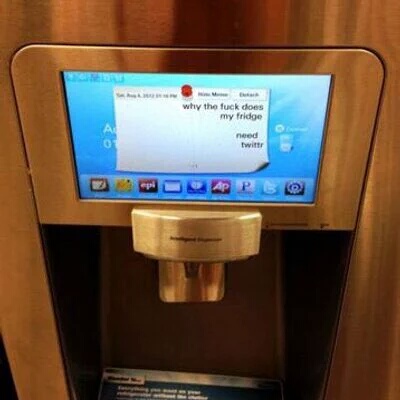
The Internet of Shit
Landmark Algorithm Breaks 30-Year Impasse
Originally shared by Richard Walker
Uncanny Valley Short Film (HD) (English & French Subtitles)
Theremin’s Bug: How the Soviet Union Spied on the US Embassy for 7 Years
A 10^8 improvement over classical computing is pretty good, you know.
A 10^8 improvement over classical computing is pretty good, you know. The idea behind simulated annealing is to search through a noisy solution space finding a good solution—though not necessarily the best solution—as quickly as possible. If you see the solution space as a (massively multi dimensional) landscape then the better solutions are like mountains in that landscape.
Imagine searching a landscape of many hills for the highest mountain, also imagine that you have to search this landscape blind and by foot. There are several methods you could use. The simplest is: always go up. That will get you up the nearest hill but it’s not likely to get you up one of the highest ones. For that you need to find intelligent ways to go down as well as up. Annealing is a probabilistic way improve the search: at the beginning go up and down often but gradually increase the tendency of going up more often that down. This enables a rapid exploration of the solution space while ratcheting up the preference for hill climbing and staying with good solutions. https://en.m.wikipedia.org/wiki/Simulated_annealing
Quantum data annealing enables exploring countless solutions simultaneously by exploiting the probabilistic properties of quantum mechanics. It is suited to problems that have discrete answers: combinations, itineraries, schedules etc. https://en.m.wikipedia.org/wiki/Quantum_annealing
 John Hardy Developer