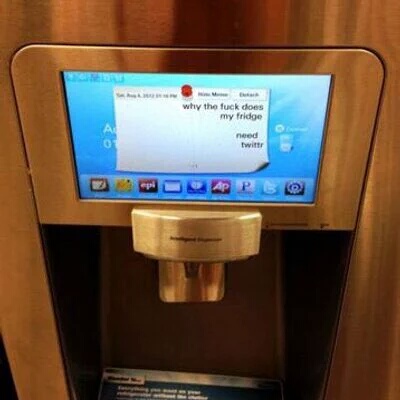
So the fridge can tweet changes in its contents and opinions, unattended. And other machines can subscribe, if they’re friends with my fridge, or if they find my fridge witty or oracular. And then we have the groundwork set for Le Printemps Arabe des Machines-Bidules.
Satyr Icon that would be ideal, but good-old-fashion laissez-faire capitalism makes that almost impossible. Think about the virtual machine wars of the 90’s and early 2000’s, between Sun Java, Oracle JRocket, Microsoft JVM, Microsoft .NET, Microsoft Silverlight, Adobe Flash, Sun JavaFX, who were all working to either monopolize the market for virtual machines the way Microsoft monopolized the operating systems market, and after multiple dozen lawsuits over patents and antitrust violations, JavaScript finally evolved enough to render all the other platforms obsolete.
Each platform found a profitable niche, but no one trusts a single closed source platform, only an open standard with a stable and reliably cross-platform API that isn’t controlled by any one entity can be trusted by everyone.
And have the tech giants learned their lesson from recent history? Not in the slightest. As the article said, there is yet another platform war, and no standard for communication between apps for multiple devices.
It took JavaScript 20 years to get where it is today, it will take about as long for IoT to develop a similarly consistent and open platform.
Scott Miller true. But I think how fast a standard, open, JavaScript-like platform for IoT can develop will depend on how much demand there is for IoT. JavaScript became the language of the web because the web became huge very quickly. I don’t see the same enthusiasm or potential for killer apps for IoT that there was for the web, which could slow IoT’s progress a lot.
Ramin Honary , why no enthusiasm ? The answer is in the article I think. An overengineered solution…
As the article is pointing out, it’s an interesting feature but it’s blown out of proportions by tech journalists. Since 1980, I have heard about “domotic”, the IT home revolution and since, the progress have been very incremental, nothing like a quantum jump.
Maybe the reason is simple: the offer is not relevant enough. As it says: what is the use of a thermostat getting off when/if my router is down…
It reminds me the old VCR program functions with 1% of the users using it 1% of the time.
Olivier Malinur it is a chicken and egg problem: the tech is terrible right now, as the article states, and this will make it hard for the consumers of the general public to become enthusiastic about buying these products. Without the promise cash from the public, there is little incentive to make the technology better, so we see thermostats that completely fail when the Internet connection is lost, rather than falling back to a manual mode of operation, and smartphone apps for controlling the devices and collecting data, but which don’t talk to other apps.
Tech companies have been trying to generate enthusiasm for IoT, but with them re-hashing the same mistakes as they have made in the past with the platform wars and lack of inter-operability between IoT apps, it may take a longer time to develop a standardized, open platform for IoT in the same way JavaScript+HTML became the standard open platform for the web.
I think the interface for smart devices is as much of a problem as anything, and I think devices like the Amazon Echo are the perfect elegant solution.
Not sure chicken and egg, Ramin Honary. Rather a clever user oriented developer, someone who will understand the needs of final users and not try to impose his/her “genius concept”.
Christopher Carr I don’t know. It’s rather surprising that Google is so far behind on this one, but they may be waiting until they can provide not only a competing device, but a competing platform.
Alexa’s platform is her real strength, with the entire thing being built upon AWS Lambda, and Google has nothing comparable yet
Christopher Carr Alexa has significantly better speed though, and having better NLP won’t help Google if it’s not easily extensible like Alexa is. Google also needs to pick a more natural name to talk to for an appliance. ‘OK Google’ Just doesn’t do it for me the same way ‘Alexa’ does.
I think their NLP advantage is significant. Were they to come out with such a device — and seeing as a speech interface is the whole point — Alexa might seem quite crude in short order.
Christopher Carr I think better NLP is a significant advantage on the phone, where search is the primary function, but search isn’t the primary use case for Alexa. Alexa shines the most when interacting with IOT devices, which don’t have nearly as much of a requirement for good NLP. I rarely run into something I want to ask Alexa that I have to word in any kind of special way for her.

 John Hardy Developer
That way you can tweet all the things you keep in the fridge, and even in the freezer. It’s a giant leap for humankind.
LikeLike
So long as the firmware is flashable, and an open source framework please.
LikeLike
So the fridge can tweet changes in its contents and opinions, unattended. And other machines can subscribe, if they’re friends with my fridge, or if they find my fridge witty or oracular. And then we have the groundwork set for Le Printemps Arabe des Machines-Bidules.
LikeLike
Oracular?
What kind of vampiric fridge is that?
LikeLike
Satyr Icon that would be ideal, but good-old-fashion laissez-faire capitalism makes that almost impossible. Think about the virtual machine wars of the 90’s and early 2000’s, between Sun Java, Oracle JRocket, Microsoft JVM, Microsoft .NET, Microsoft Silverlight, Adobe Flash, Sun JavaFX, who were all working to either monopolize the market for virtual machines the way Microsoft monopolized the operating systems market, and after multiple dozen lawsuits over patents and antitrust violations, JavaScript finally evolved enough to render all the other platforms obsolete.
Each platform found a profitable niche, but no one trusts a single closed source platform, only an open standard with a stable and reliably cross-platform API that isn’t controlled by any one entity can be trusted by everyone.
And have the tech giants learned their lesson from recent history? Not in the slightest. As the article said, there is yet another platform war, and no standard for communication between apps for multiple devices.
It took JavaScript 20 years to get where it is today, it will take about as long for IoT to develop a similarly consistent and open platform.
LikeLike
That’s hilarious.
LikeLike
So it can tweet you a warning if the power goes out.
LikeLike
Ramin Honary historical measures are not a good basis for future predictions because technological growth is not linear, it accelerates.
LikeLike
Scott Miller true. But I think how fast a standard, open, JavaScript-like platform for IoT can develop will depend on how much demand there is for IoT. JavaScript became the language of the web because the web became huge very quickly. I don’t see the same enthusiasm or potential for killer apps for IoT that there was for the web, which could slow IoT’s progress a lot.
LikeLike
until it just stops, abruptly…
LikeLike
Ramin Honary , why no enthusiasm ? The answer is in the article I think. An overengineered solution…
As the article is pointing out, it’s an interesting feature but it’s blown out of proportions by tech journalists. Since 1980, I have heard about “domotic”, the IT home revolution and since, the progress have been very incremental, nothing like a quantum jump.
Maybe the reason is simple: the offer is not relevant enough. As it says: what is the use of a thermostat getting off when/if my router is down…
It reminds me the old VCR program functions with 1% of the users using it 1% of the time.
LikeLike
Olivier Malinur it is a chicken and egg problem: the tech is terrible right now, as the article states, and this will make it hard for the consumers of the general public to become enthusiastic about buying these products. Without the promise cash from the public, there is little incentive to make the technology better, so we see thermostats that completely fail when the Internet connection is lost, rather than falling back to a manual mode of operation, and smartphone apps for controlling the devices and collecting data, but which don’t talk to other apps.
Tech companies have been trying to generate enthusiasm for IoT, but with them re-hashing the same mistakes as they have made in the past with the platform wars and lack of inter-operability between IoT apps, it may take a longer time to develop a standardized, open platform for IoT in the same way JavaScript+HTML became the standard open platform for the web.
LikeLike
I think the interface for smart devices is as much of a problem as anything, and I think devices like the Amazon Echo are the perfect elegant solution.
LikeLike
Scott Miller When do you reckon Google will come out with an Echo-type thing?
LikeLike
Not sure chicken and egg, Ramin Honary. Rather a clever user oriented developer, someone who will understand the needs of final users and not try to impose his/her “genius concept”.
LikeLike
Christopher Carr I don’t know. It’s rather surprising that Google is so far behind on this one, but they may be waiting until they can provide not only a competing device, but a competing platform.
Alexa’s platform is her real strength, with the entire thing being built upon AWS Lambda, and Google has nothing comparable yet
LikeLike
Scott Miller Ah. But Google’s NLP is way better — Alexa is pretty stupid. Can’t handle pronoun referents and such.
LikeLike
Christopher Carr Alexa has significantly better speed though, and having better NLP won’t help Google if it’s not easily extensible like Alexa is. Google also needs to pick a more natural name to talk to for an appliance. ‘OK Google’ Just doesn’t do it for me the same way ‘Alexa’ does.
LikeLike
Scott Miller
Yeah, Google is not at all good at naming things.
I think their NLP advantage is significant. Were they to come out with such a device — and seeing as a speech interface is the whole point — Alexa might seem quite crude in short order.
Speed, yes. Would need some optimization.
LikeLike
Christopher Carr I think better NLP is a significant advantage on the phone, where search is the primary function, but search isn’t the primary use case for Alexa. Alexa shines the most when interacting with IOT devices, which don’t have nearly as much of a requirement for good NLP. I rarely run into something I want to ask Alexa that I have to word in any kind of special way for her.
LikeLike